


Abstract
This article examines how Ghana’s digital transformation of passport application processes under the Ministry of Foreign Affairs and Diaspora Relations illustrates the potential of e-governance to reduce corruption, eliminate exploitative middlemen (Goro boys), and improve service trust and efficiency. It traces the evolution from manual paper applications, online forms, and appointment-based queue management to the current 24-hour expedited passport service, fee reductions (GHS 350–GHS 2,000), real-time tracking, and cashless payments via the Ghana.Gov platform. Using the passport system as a case study, the paper argues that digital public infrastructure (DPI) can serve as a model for other government institutions seeking to curb corruption and enhance transparency.
Keywords: digital service delivery, e-governance, digital transformation, corruption reduction, Ghana.Gov, passport application, Ghana, digital public infrastructure, jobs, economic growth
Background Context: Evolution of Ghana Passport Application Processes
Early Manual and Paper-Based System
Originally, Ghanaian passport applications were processed through entirely manual, paper-based systems. Applicants had to visit passport offices physically, obtain paper forms, and submit documents in person, often without clear timelines or transparent procedures. This opacity created fertile ground for intermediaries commonly called “Goro boys” who exploited applicants by promising faster processing, charging unofficial fees, and controlling access to officers.
The lack of digital records and centralized tracking meant that applications could be delayed, lost, or manipulated, with little accountability. Citizens faced unpredictable wait times and had no way to verify the status of their applications, which reinforced distrust in public service delivery.
Transition to Online Form Application
The first major digital shift was the introduction of online passport application forms. This change allowed applicants to fill and submit forms electronically before visiting offices, reducing some of the physical congestion and initial paperwork. Even so, many downstream processes payment, document verification, appointment scheduling, and issuance remained manual or partially digital, leaving room for continued manipulation by intermediaries.
Nevertheless, this step marked a critical move towards digitizing the front-end of the service, laying the groundwork for more integrated systems.
Digital Appointment Booking and Queue Management
The next phase introduced digital appointment booking and queue management systems. Applicants could now book specific time slots, reducing overcrowding and “first-come-first-served” chaos at offices. This reform improved predictability for citizens and reduced the ability of middlemen to “reserve” slots or manipulate entry into the office.
By tying appointment times to applicant identities and linking them to backend processing workflows, the system started to create auditable records of those who entered the office and when, weakening the informal control previously held by intermediaries.
Current 24-Hour Expedited Service and Full Digital Integration
Under the current administration, the passport application process has been significantly reformed:
- A 24-hour expedited passport service is available at GHS 2,000 for urgent needs.
- The standard application fee has been reduced from GHS 500 to GHS 350, with paraphernalia and processing costs now clearly structured within the GHS 350–GHS 2,000 range.
- Processing times have been standardized: normal applications are processed within 15 days, depending on factors such as document completeness and regional logistics.
- An electronic tracking system allows applicants to monitor the status of their applications in real time from approval to printing and delivery.
- All payments are made through the Ghana.Gov payment portal, eliminating cash payments and the need for middlemen to handle money.
- The Ministry has dismantled intermediary operations and is actively pursuing individuals found exploiting applicants.
- Nationwide doorstep delivery of passports is now available at no additional cost, further reducing the need for physical visits and informal facilitation.
These reforms collectively represent a shift from opaque, manual processes to a transparent, end-to-end digital service model. The passport portal at https://passport.mfa.gov.gh is now widely cited as a good example of digital governance and service delivery in Ghana
Digital Service Delivery as an Anti-Corruption Tool
How Digitalization Reduces Corruption and Middlemen
The passport case illustrates several mechanisms by which digital service delivery can curb corruption:
- End-to-end traceability: Digital records of applications, payments, and processing steps create an audit trail that limits opportunities for tampering or informal “favor-based” processing.
- Cashless payments: Integrating with Ghana.Gov ensures that all payments go directly to the government’s revenue account, removing the possibility of cash skimmed by intermediaries or corrupt staff.
- Transparent timelines and tracking: Real-time status updates and standardized processing times reduce uncertainty, limiting the leverage that middlemen traditionally held by promising “special treatment”.
- Reduced human gatekeeping: Automated appointment systems, online forms, and digital workflows reduce the number of manual touchpoints where discretion can be abused.
Research on digitalisation and public service delivery in Ghana has found that digital tools can weaken traditional corruption channels by making processes more transparent and predictable, although implementation quality and institutional capacity remain critical
Lessons for Other Government Institutions
The passport model can be adapted by other agencies to achieve similar gains:
- Driver and Vehicle Licensing Authority (DVLA): Already cited alongside passports as a sector where digitalization has driven out corruption. Expanding online licensing, digital payment, and tracking can further reduce intermediaries.
- Tax Administration (GRA): Digital filing, e-payment, and automated audit triggers can reduce under-reporting and informal facilitation fees.
- Land and Property Administration: Digital land registries, e-conveyancing, and online payments can reduce fraud and middleman exploitation in land transactions.
- Civil Registration and National ID: Integrated digital identity systems can streamline access to services and reduce duplicate or fraudulent registrations.
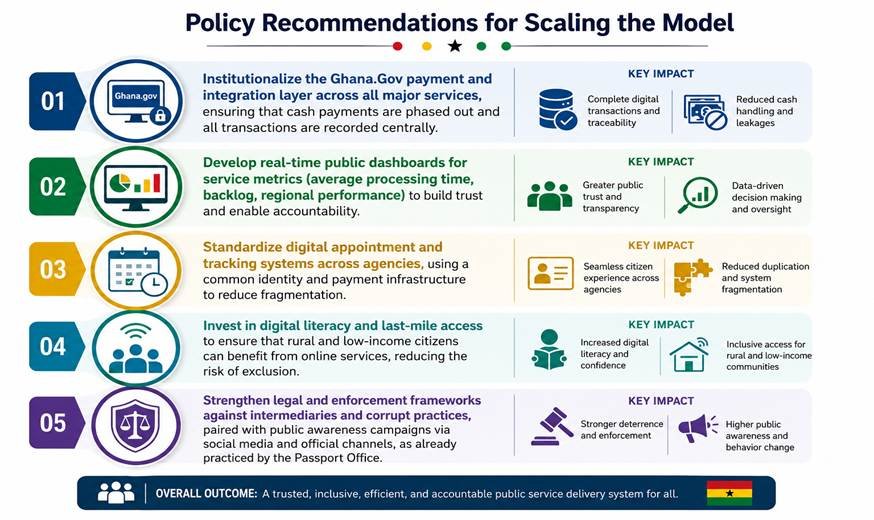
Each of these institutions can adopt a passport-like model: online application, digital appointment, cashless payment via Ghana.Gov, real-time tracking, and performance dashboards publicly accessible to citizens.
Digital Transformation, E-Governance, and Economic Growth
Ghana’s E-Governance and Digital Public Infrastructure
Ghana has been actively building digital public infrastructure (DPI) that underpins e-governance: integrated identity systems, digital payment platforms (including Ghana.Gov and mobile money), and interoperable data systems. These layers enable services like passport applications to be delivered seamlessly, transparently, and at scale.
The GSMA report on Ghana’s digital transformation estimates that improvements in e-government could raise GHS 5.8 billion in tax revenues by reducing leakage and improving collection efficiency. This reflects not only reduced corruption but also broader improvements in administrative efficiency and citizen trust.
Job Creation and Economic Growth
Digital transformation in Ghana is not only about efficiencies; it is also a growth strategy:
- Mobile connectivity already contributes 8% of GDP (GHS 94 billion), and strategic reforms could add $3.4 billion to the economy by 2030.
- In agriculture, digital tools could add GHS 10.5 billion in value and create 190,000 new jobs.
- In manufacturing, adoption of IoT and AI could generate an additional GHS 15 billion, especially in cocoa and gold processing.
- E-government improvements can boost tax collection, which in turn supports public investment in infrastructure, education, and health further stimulating growth and employment.
For the passport system specifically, digital transformation has created new roles in IT, data management, customer service, and logistics (e.g., nationwide delivery operations), while also reducing the informal “Goro boy” economy that previously extracted value from citizens without adding productive output.
References
Abdul-Salam, A., et al. (2024). Examining the linkages between digitalisation, public service delivery and corruption in Ghana. Transforming Government: People, Process and Policy, 18.
Ghana Ministry of Foreign Affairs. (2025, November 12). Minister for Foreign Affairs outlines significant achievements in passport reforms. Ministry of Foreign Affairs and Regional Diplomacy.
GSMA. (2025). Driving digital transformation of the economy in Ghana. GSMA.
JoyOnline. (2022, April 10). “Digitalisation yielding fruits in the fight against corruption” – Bawumia.
Osafo-Maafo, Y. (2024, January 26). Digitalization has driven out corruption in passport office, DVLA
Digital Public Infrastructure Africa. (2024, July 1). Transforming governance: The impact of digital public infrastructure on public services in Ghana. DPI Africa.
IMF. (2024). Ghana: Technical Assistance Report – Governance Diagnostic Assessment. IMF Technical Assistance Report No. 25/91.
Wireko, C., & Skouby, K. (2015). Transition to e-government in developing countries: The case of Driver and Vehicle Licensing Authority (DVLA) e-service Smart City initiatives in Ghana.
Author: Abraham Fiifi Selby – Researcher & Information Technology Policy Advocate (selby@abrahamselby.com).
This Publication is written in authors own capacity, not affiliated with any of the membership organization.